 Union Post UK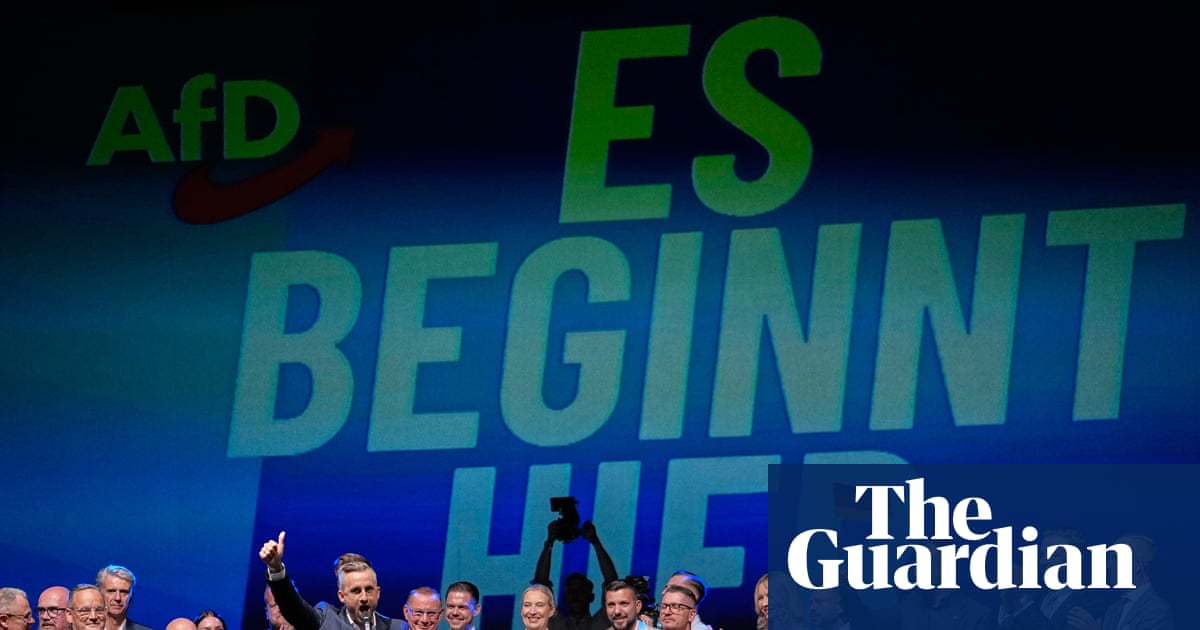
Across Germany – and Europe more widely – there has been a palpable sense of shock and disbelief after the far-right Alternative für Deutschland (AfD) swept to a historic state election victory in Saxony-Anhalt on Monday. The AfD won 44% of the vote, marking a historic moment as a far-right party has been propelled to the brink of power at regional level in Germany for the first time since the Nazis.
The resonance was stark in the UK too: as the results came in, hundreds of black-clad activists intent on blocking migrant arrivals were battling with police for a second night along England’s south coast. While seasoned observers note that Saxony-Anhalt, a small state in the former communist east of Germany, has traditionally voted further to the right, the AfD’s victory has crossed a red line. A far-right party has been propelled to the brink of power at regional level in Germany for the first time since the Nazis.
For today’s analysis, the Guardian’s Berlin correspondent Kate Connolly and Europe correspondent Jon Henley discuss why Germany’s firewall against the far right has failed and what happens next.
**Why is the AfD on the rise?** The German chancellor, Friedrich Merz, was elected leader of the centre-right Christian Democratic Union (CDU) in 2022 on a pledge to halve the AfD’s vote. Instead, it has doubled, and support for his centrist coalition has collapsed. A “deeply shocked” Merz vowed to stay in office after the AfD triumphed with 44% of the vote, just short of an absolute majority. The turnout in Saxony-Anhalt was breathtaking at 77.8%, compared with 60.3% in 2021, suggesting the AfD has energized many who didn’t vote at all five years ago.
Research indicates that while one in three AfD supporters align with the party’s extremist ideology, its growing popularity is driven by a diversity of voters who feel alienated from mainstream politics. Ulrich Siegmund, the AfD’s lead candidate in Saxony-Anhalt, is a charismatic former perfume salesman who has weaponized voter discontent around the faltering economy and migration. Despite irregular immigration reducing since Merz came into office, Siegmund has capitalized on a mood of ostalgie—nostalgia for communist East Germany—and bubbling resentment among poorer east Germans who view themselves as second-class citizens compared to people from the west. Strikingly, one of the highest shares of the AfD’s vote came from the 35- to 44 age group, who were children or infants when the Berlin Wall came down.
**What does the result mean for Germany?** There’s debate about whether the previous consensus over how mainstream parties should deal with the far right—the so-called “Brandmauer” (firewall)—has backfired. Critics argue that non-cooperation with the AfD at any level from local councils up to federal government has allowed the party to escape scrutiny. Another criticism is that it has neutered the political mainstream, forcing compromises that have resulted in ineffective government and further fueling the extremes.
Now, coalition talks are underway for the parties in Saxony-Anhalt. While Siegmund has rejected leading a minority administration, initial indications suggest the AfD could govern with the hard-left, pro-Russian Bündnis Sahra Wagenknecht party, which received 5.3% of the vote. If successful, Siegmund will become the state’s first far-right governor, controlling significant policy areas including education, policing, and public broadcasting. The AfD has proposed revisions to the school curriculum, defunding anti-racism initiatives, and removing pride flags. Jon Henley suggests the AfD might also make changes to civil service recruitment to create a more supportive environment.
Securing Saxony-Anhalt’s government would also give the AfD seats in the Bundesrat, the upper house. While they wouldn’t have enough seats to block legislation, they could still act as a disruptive force. With the AfD leading the polls nationally, there’s a likely ripple effect across the country. More state elections are scheduled later this month, including in traditionally liberal Berlin, where the AfD is now polling at 18%, with the CDU maintaining a slim lead in the early 20s. If their vote share rises across states, coalition-building without the AfD becomes increasingly convoluted, further flattening the mainstream’s ability to govern confidently.
**For Europe?** Not all of Europe’s far-right leaders have welcomed this development. Jon Henley, based in Paris, notes that France’s National Rally, under Marine Le Pen, has spent years detoxifying its image. However, the AfD’s extreme stance—including support for mass deportations and downplaying Nazi crimes—has led to its expulsion from Europe’s far-right parliamentary group, which includes Italian Prime Minister Giorgia Meloni. Any domestic shock waves in Europe’s largest economy will inevitably affect the bloc. “A weakened German government in complete upheaval would obviously be bad news for Europe,” says Jon. It could impact migration policy, the environment (as the AfD is famously climate-skeptical), and Ukraine, given the AfD’s pro-Kremlin stance.
In a press conference, Merz drew an explicit link between the AfD and Russia, noting that “2,500 km in the east, the election results were being celebrated.” This reflects growing calls within the CDU and Social Democrats for Merz to toughen his stance on Russia. After a drone attack on Leipzig airport in August, the German government took a month before publicly blaming Moscow, though the language was direct when Foreign Minister Johann Wadephul stated: “We are not at war, but we are a daily target of hybrid warfare.”
**Broader Implications** The AfD’s landslide victory can be viewed as an indication of coming peril across Europe. With federal or presidential elections taking place in Spain, France, Italy, and Poland over the next two years, the AfD’s success raises questions about how to address the far right’s growing influence. Jon Henley argues that the far right’s ideas have been steadily normalized by the media and political center, framing the immigration debate and leaving mainstream parties scrambling to react. Political scientists across Europe say this result is a failure by mainstream parties to come up with inspiring policies that address the reasons why voters choose the far right.
**Conclusion** The AfD’s historic victory in Saxony-Anhalt marks a turning point in Germany’s political landscape. The party’s rise reflects deep-seated grievances among voters, particularly in the east, and challenges the traditional firewall against far-right parties. The coming coalition talks and future state elections will determine how Germany—and Europe—respond to this seismic shift.
Source: The Guardian